The 7 red-flag profiles top universities quietly reject
These are patterns we see again and again in applications from Indian and Gulf students, not judgements about any one child. None of them is an automatic rejection, and every single one is fixable. Get the full guide, with a self-check for each.
Seven patterns. A self-check for each. A printable PDF to review together. About 20 minutes as a family.
The 7 patterns
What a counsellor notices, before anyone counts marks.
Top universities rarely turn a student down for one bad line. They pass on patterns. Here are the seven we see most often. Unlock the full guide below for why each one hurts, how to fix it, and a self-check you can do together.
1
The Certificate Collector
Fourteen online certificates, zero output.
2
The Paid-Programme Badge
A famous campus on the list, very little of the student's own work.
3
The Coaching-Centre Topper
Brilliant marks, no curiosity beyond the syllabus.
4
The Photo-Op Volunteer
One-off drives and service trips, no cause that lasts.
5
The Default Engineer
CS or engineering chosen by family or friends, and nothing in the file shows it.
6
The Borrowed Voice
An essay that sounds forty-five, or sounds like AI.
7
The Founder of Everything
Three "startups", no users.
Get the guide
Tell us where to send it, and the full guide opens right here.
Fill in the short form and all seven red-flag profiles unlock on this page straight away, each with why it hurts, how to fix it, a self-check and an illustrative example. You also get a printable PDF to review with your child. Our Dubai and Pune team can give the profile a free second read.
We use your details to send the guide and, if you want it, to arrange a free profile review. No spam.
Your guide is unlocked.
Read it with your child. Your self-check ticks are saved on this device.
Each pattern below weakens an application. None is an automatic rejection, and each one has a clear fix. Every example is illustrative, never a real student.
1FLAG
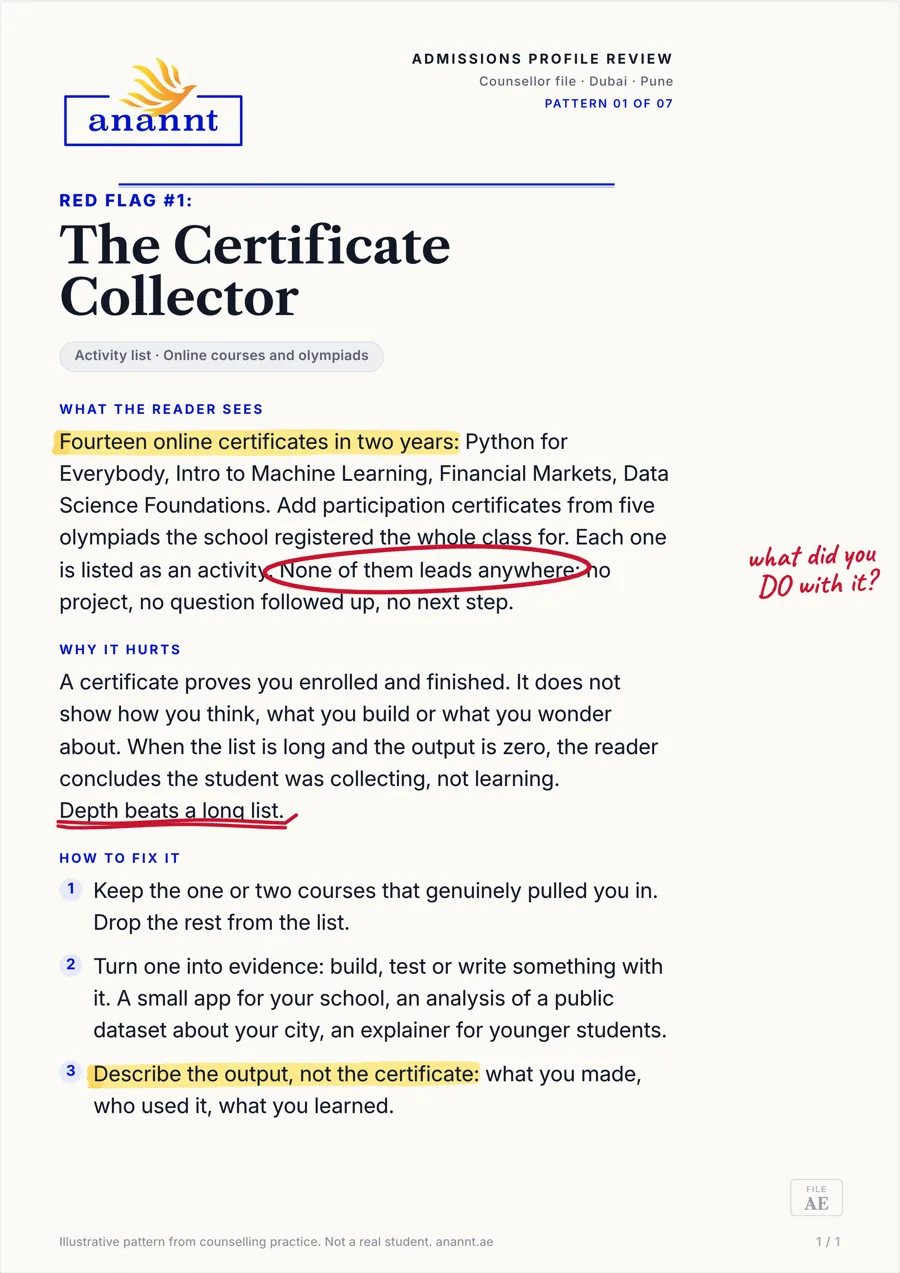
The Certificate Collector
Activity list · Online courses and olympiads
What the reader sees
Fourteen online certificates in two years: Python for Everybody, Intro to Machine Learning, Financial Markets, Data Science Foundations. Add participation certificates from five olympiads the school registered the whole class for. Each one is listed as an activity. None of them leads anywhere: no project, no question followed up, no next step.
Why it hurts
A certificate proves you enrolled and finished. It does not show how you think, what you build or what you wonder about. When the list is long and the output is zero, the reader concludes the student was collecting, not learning. Depth beats a long list.
How to fix it
Keep the one or two courses that genuinely pulled you in. Drop the rest from the list.
Turn one into evidence: build, test or write something with it. A small app for your school, an analysis of a public dataset about your city, an explainer for younger students.
Describe the output, not the certificate: what you made, who used it, what you learned.
Illustrative pattern from counselling practice. Not a real student.
What universities say
"We don't expect applicants to do a million things. Choose quality over quantity."
WeakCompleted fourteen online certificates in Python, machine learning and finance.
StrongerAfter a Python course, built a small attendance tracker for our building's weekend cricket group and wrote up the two bugs that took longest to fix.
2FLAG
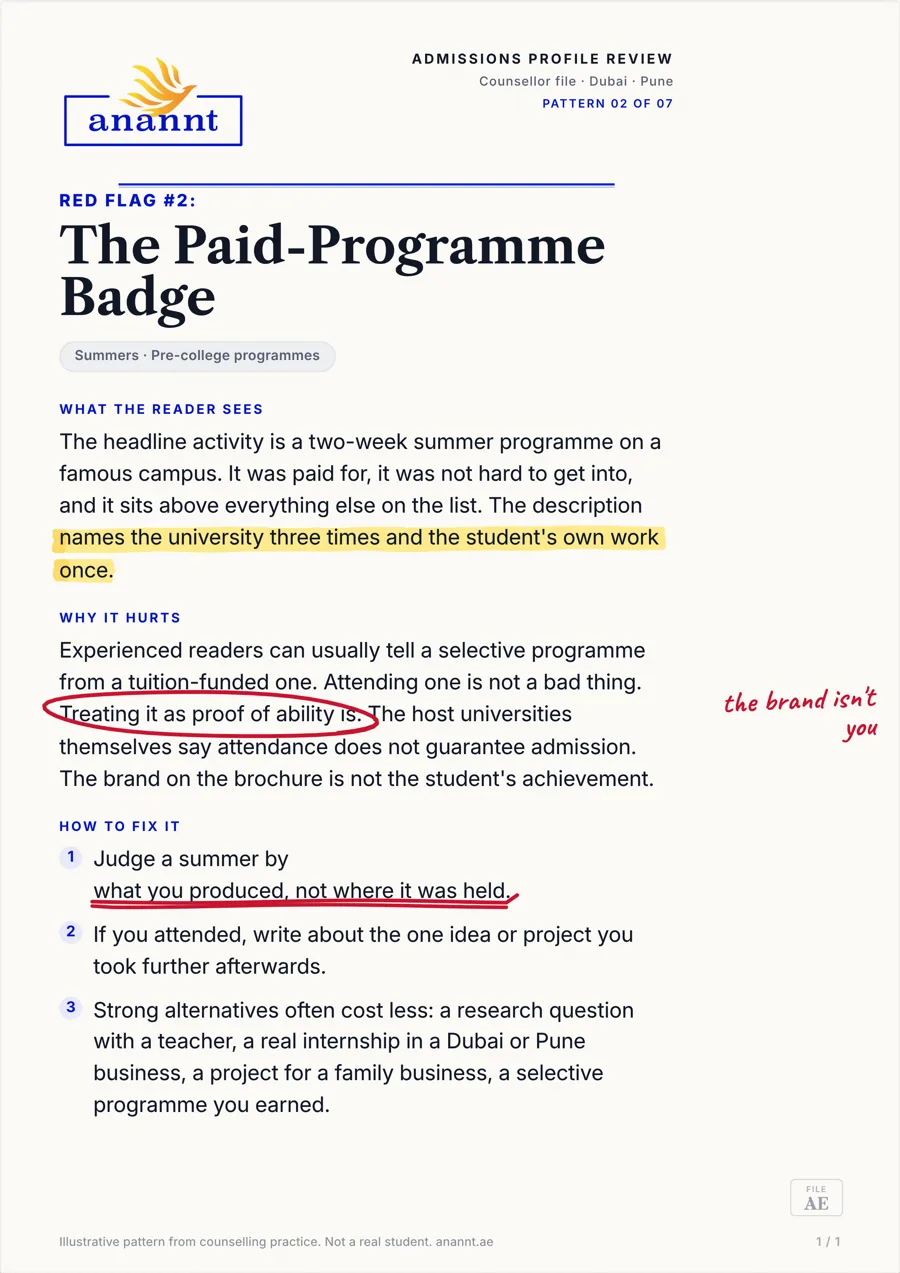
The Paid-Programme Badge
Summers · Pre-college programmes
What the reader sees
The headline activity is a two-week summer programme on a famous campus. It was paid for, it was not hard to get into, and it sits above everything else on the list. The description names the university three times and the student's own work once.
Why it hurts
Experienced readers can usually tell a selective programme from a tuition-funded one. Attending one is not a bad thing. Treating it as proof of ability is. The host universities themselves say attendance does not guarantee admission. The brand on the brochure is not the student's achievement.
How to fix it
Judge a summer by what you produced, not where it was held.
If you attended, write about the one idea or project you took further afterwards.
Strong alternatives often cost less: a research question with a teacher, a real internship in a Dubai or Pune business, a project for a family business, a selective programme you earned.
Illustrative pattern from counselling practice. Not a real student.
What universities say
Harvard Summer School states that attending the Pre-College Program "does not guarantee admission to Harvard".
WeakAttended a two-week summer programme on a famous university campus.
StrongerTook a question from a summer course and ran a small survey of thirty classmates on study habits, then shared what I found with our school's wellbeing team.
3FLAG
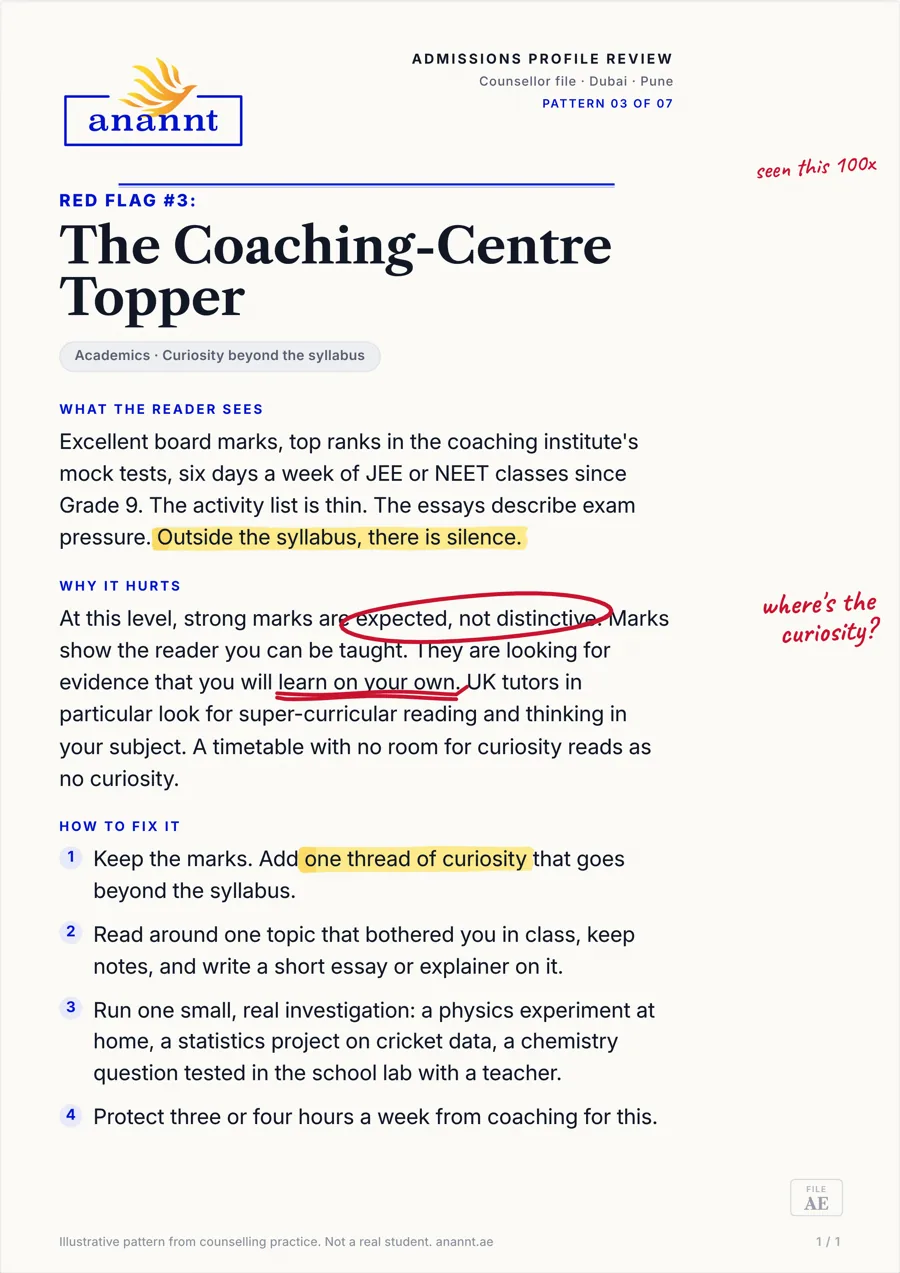
The Coaching-Centre Topper
Academics · Curiosity beyond the syllabus
What the reader sees
Excellent board marks, top ranks in the coaching institute's mock tests, six days a week of JEE or NEET classes since Grade 9. The activity list is thin. The essays describe exam pressure. Outside the syllabus, there is silence.
Why it hurts
At this level, strong marks are expected, not distinctive. Marks show the reader you can be taught. They are looking for evidence that you will learn on your own. UK tutors in particular look for super-curricular reading and thinking in your subject. A timetable with no room for curiosity reads as no curiosity.
How to fix it
Keep the marks. Add one thread of curiosity that goes beyond the syllabus.
Read around one topic that bothered you in class, keep notes, and write a short essay or explainer on it.
Run one small, real investigation: a physics experiment at home, a statistics project on cricket data, a chemistry question tested in the school lab with a teacher.
Protect three or four hours a week from coaching for this.
Illustrative pattern from counselling practice. Not a real student.
What universities say
On super-curricular activities, Cambridge says "your experience of them and your reflections are more important than the number of different activities you've pursued".
WeakTop ranks in institute mock tests; six days a week of coaching since Grade 9.
StrongerKept the marks, and after a chapter on probability spent Sunday mornings analysing three seasons of local cricket scores, writing up what surprised me.
4FLAG
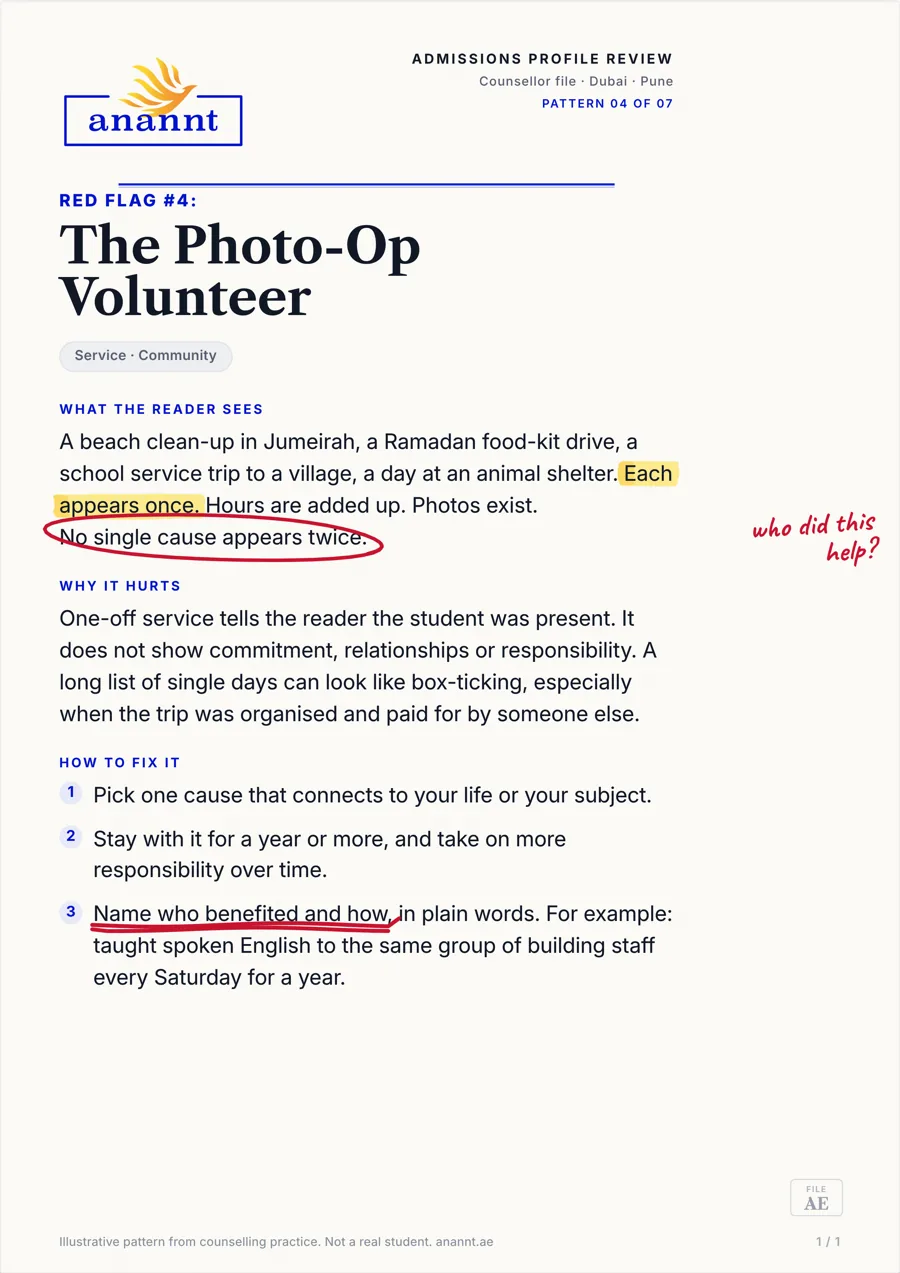
The Photo-Op Volunteer
Service · Community
What the reader sees
A beach clean-up in Jumeirah, a Ramadan food-kit drive, a school service trip to a village, a day at an animal shelter. Each appears once. Hours are added up. Photos exist. No single cause appears twice.
Why it hurts
One-off service tells the reader the student was present. It does not show commitment, relationships or responsibility. A long list of single days can look like box-ticking, especially when the trip was organised and paid for by someone else.
How to fix it
Pick one cause that connects to your life or your subject.
Stay with it for a year or more, and take on more responsibility over time.
Name who benefited and how, in plain words. For example: taught spoken English to the same group of building staff every Saturday for a year.
Illustrative pattern from counselling practice. Not a real student.
Self-check
Illustrative example, not a real student
WeakBeach clean-up, Ramadan food drive, village service trip, animal shelter visit.
StrongerTaught spoken English to the same group of building staff every Saturday for a year, and trained two friends to help run the sessions.
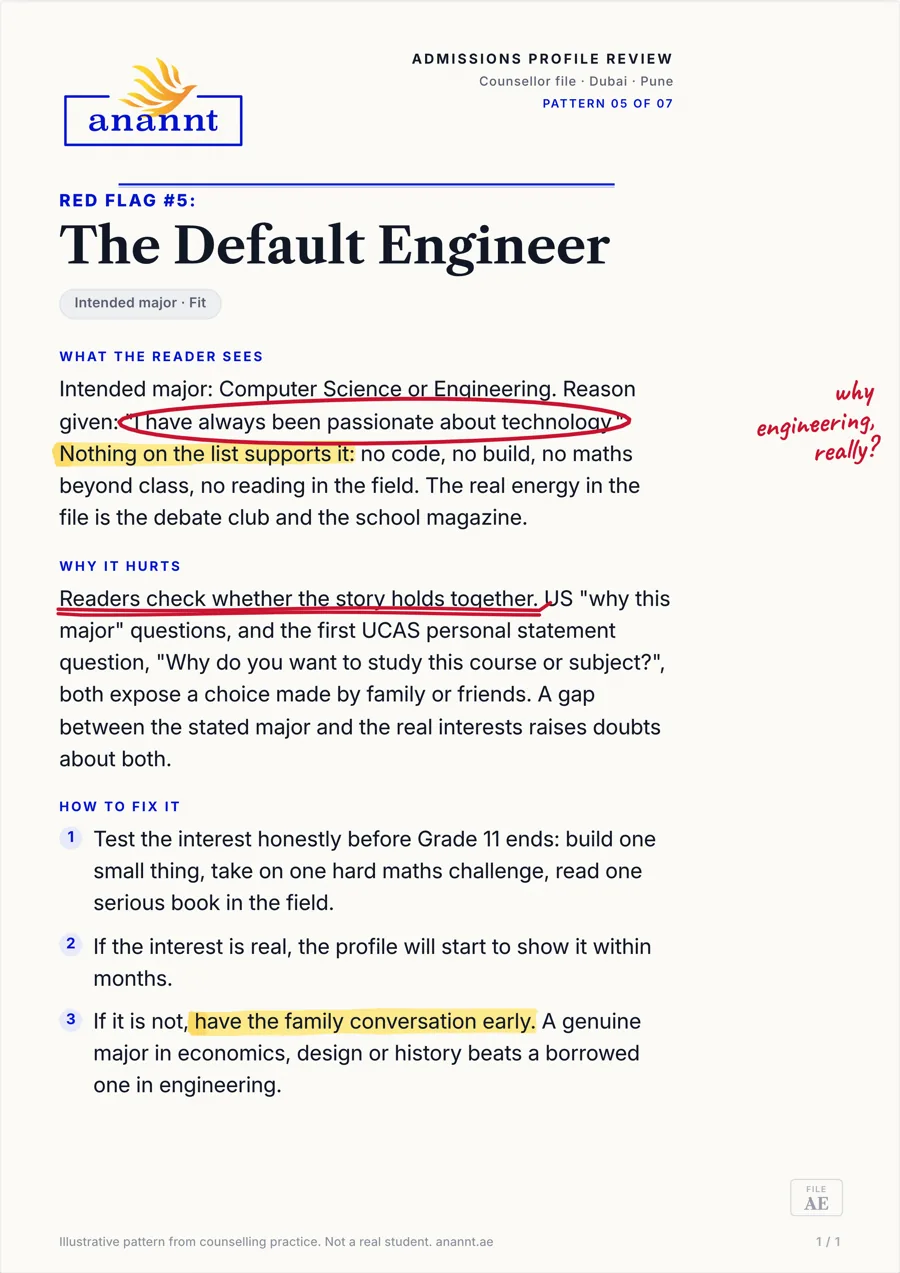
5FLAG
The Default Engineer
Intended major · Fit
What the reader sees
Intended major: Computer Science or Engineering. Reason given: "I have always been passionate about technology." Nothing on the list supports it: no code, no build, no maths beyond class, no reading in the field. The real energy in the file is the debate club and the school magazine.
Why it hurts
Readers check whether the story holds together. US "why this major" questions, and the first UCAS personal statement question, "Why do you want to study this course or subject?", both expose a choice made by family or friends. A gap between the stated major and the real interests raises doubts about both.
How to fix it
Test the interest honestly before Grade 11 ends: build one small thing, take on one hard maths challenge, read one serious book in the field.
If the interest is real, the profile will start to show it within months.
If it is not, have the family conversation early. A genuine major in economics, design or history beats a borrowed one in engineering.
Illustrative pattern from counselling practice. Not a real student.
What universities say
UCAS lists three questions for the personal statement; the first is "Why do you want to study this course or subject?".
UCAS, How to write your personal statement: 2026 entry onwards. ucas.com
Self-check
Illustrative example, not a real student
WeakIntended major: Computer Science. "I have always been passionate about technology."
StrongerIntended major: Economics, after working out the weekend pricing for our family shop and reading two books on behavioural economics over the summer.
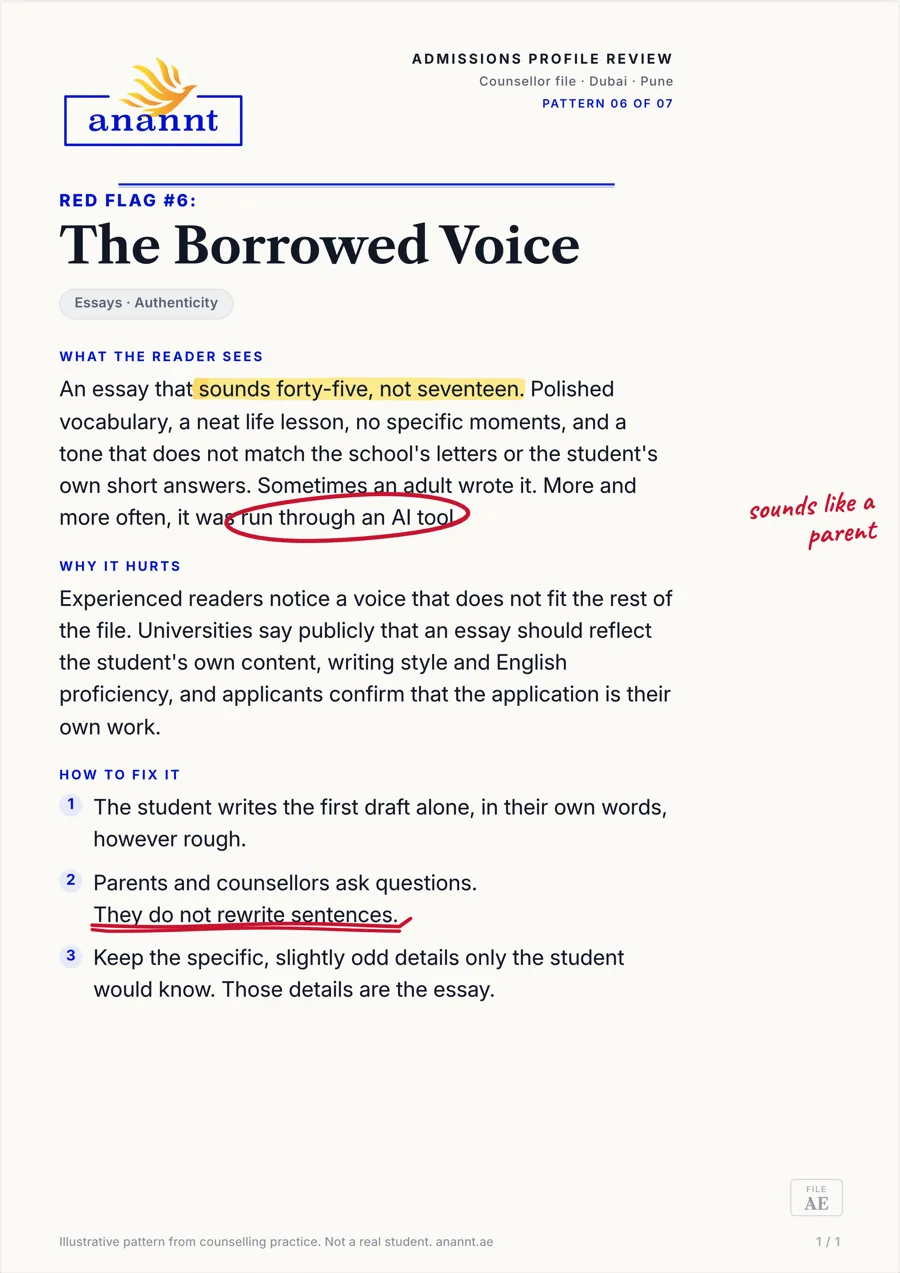
6FLAG
The Borrowed Voice
Essays · Authenticity
What the reader sees
An essay that sounds forty-five, not seventeen. Polished vocabulary, a neat life lesson, no specific moments, and a tone that does not match the school's letters or the student's own short answers. Sometimes an adult wrote it. More and more often, it was run through an AI tool.
Why it hurts
Experienced readers notice a voice that does not fit the rest of the file. Universities say publicly that an essay should reflect the student's own content, writing style and English proficiency, and applicants confirm that the application is their own work.
How to fix it
The student writes the first draft alone, in their own words, however rough.
Parents and counsellors ask questions. They do not rewrite sentences.
Keep the specific, slightly odd details only the student would know. Those details are the essay.
Illustrative pattern from counselling practice. Not a real student.
What universities say
"A student's essay should reflect their own content, writing style, and English proficiency." Applicants also affirm, through the Common App, that the work is "my own work, factually true, and honestly presented."
Harvard College FAQ, What help can students receive in writing their essays. college.harvard.edu
Self-check
Illustrative example, not a real student
WeakA polished essay about resilience, with a neat life lesson and no specific moments.
StrongerA first draft, in the student's own words, about the Tuesday the biryani burned during their first catering order, and the one thing they changed the next week.
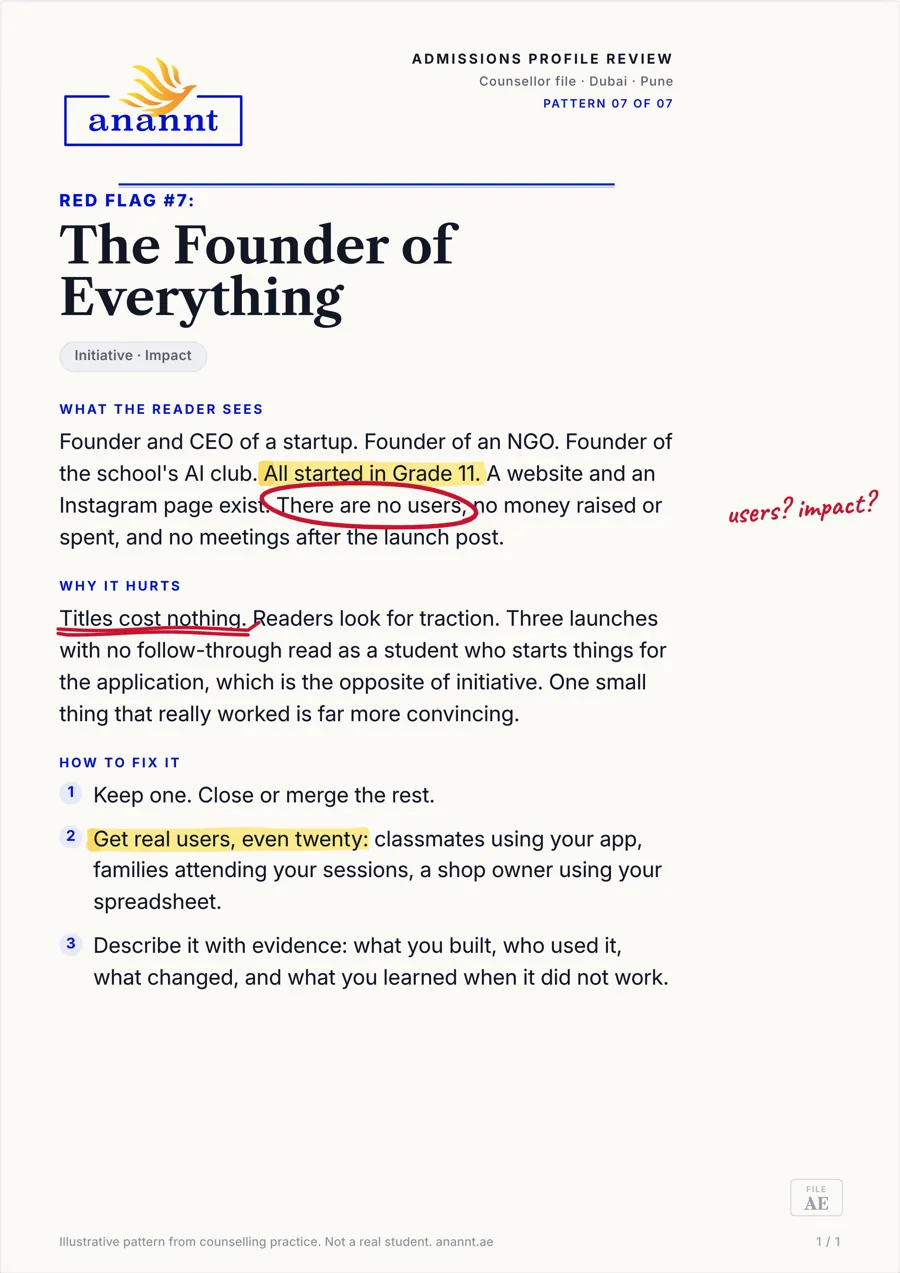
7FLAG
The Founder of Everything
Initiative · Impact
What the reader sees
Founder and CEO of a startup. Founder of an NGO. Founder of the school's AI club. All started in Grade 11. A website and an Instagram page exist. There are no users, no money raised or spent, and no meetings after the launch post.
Why it hurts
Titles cost nothing. Readers look for traction. Three launches with no follow-through read as a student who starts things for the application, which is the opposite of initiative. One small thing that really worked is far more convincing.
How to fix it
Keep one. Close or merge the rest.
Get real users, even twenty: classmates using your app, families attending your sessions, a shop owner using your spreadsheet.
Describe it with evidence: what you built, who used it, what changed, and what you learned when it did not work.
Illustrative pattern from counselling practice. Not a real student.
What universities say
"Tutoring a single kid in math changes the world."
On super-curricular activities: "your experience of them and your reflections are more important than the number of different activities you've pursued"; unrelated extra-curricular activities "won't be taken into consideration".
"A student's essay should reflect their own content, writing style, and English proficiency." plus the Common App affirmation "my own work, factually true, and honestly presented."
Public sources verified 24 October 2026. University pages change, so please check each link for the current wording.
Talk to the right person
Want a second pair of eyes on your child's profile?
A free profile review is a short, honest conversation about which flag matters most for your child, what to keep, what to deepen, and what the next few months could look like. Message our Dubai team, call our India number, or book a call.