Anannt Education

Digital SAT Reading and Writing gap-coverage test

Thirty items on structures that still sit outside Bluebook Practice Tests 4–11. After you submit, you will see accuracy, pacing, and each official Question Bank rationale.

  • 30 questions
  • 40 minutes
  • One at a time
  • All 10 R&W skills
Math gap-coverage test

The timer starts when you begin. It cannot be paused. The module submits at 00:00.

How the module works

  1. One question on screen, then Next. Go back, mark for review, or jump from the question menu.
  2. After you submit, you will see accuracy and time on each item.
  3. Official Question Bank rationales unlock only after submission.

What this is not

  • Not an official College Board test or an SAT score.
  • Not a full-length adaptive Bluebook simulation.
  • The comparison baseline is official Practice Tests 4–11, including Test 11.

For a scored official practice experience, use Bluebook practice tests.

Why these 30 questions

The set concentrates architectures that add something beyond repeated Bluebook practice: cross-text transfer, research-validity reasoning, interaction effects, multi-part evidence, high-density punctuation, modifier/comparison logic, and dual-goal rhetorical synthesis. The specific selection reason for each item stays hidden until submission.

Anannt Education R&W
40:00
Coverage rule: Bluebook Practice Tests 4–11 are the comparison baseline; Test 11 is included. Do not use the explanations until you have submitted.

Check your work

Jump to any question, or submit this module. Unanswered items can still be opened from this list. 0 of 30 answered.

Anannt Education

Score and timing analysis

0/30
0/30Correct
0sAverage time / question
0sMedian time
1:20Target pace (40 ÷ 30)

Skill breakdown

What the timing says

    Time on each question

    Question review

    Select a row to reopen that question with the rationale. Time is how long the item was on screen, including later revisits.

    Q Domain Skill Your answer Correct answer Result Time Pace
    Explore SAT preparation Math gap-coverage test Discuss the result
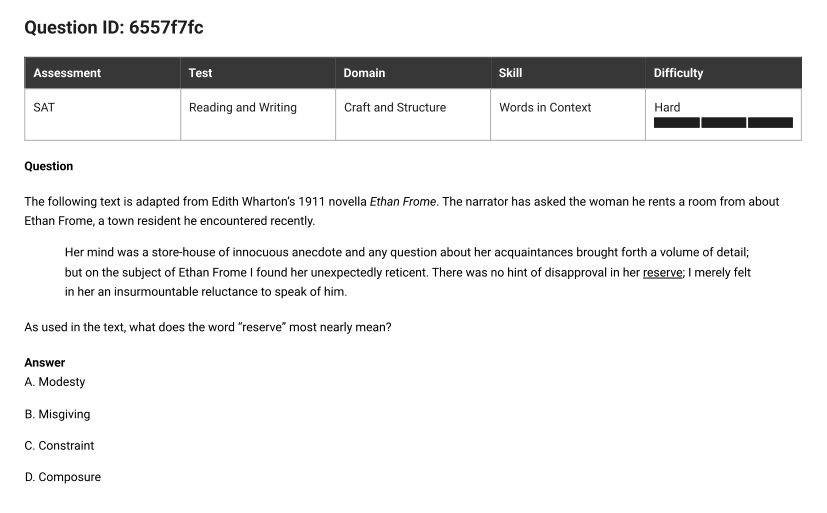
    Question 1Craft and Structure · Words in Context
    ID 6557f7fc
    Question 1, source Question ID 6557f7fc
    Select the question image to open a full-resolution view.
    WHY THIS QUESTION IS IN THE GAP-COVERAGE SET
    Meaning-in-context from behavior, not a synonym lookup
    The current Tests 4–11 contain relatively few “As used in the text” items compared with standard blank-completion vocabulary. Here, “reserve” must be inferred from the narrator’s description of reluctance, so connotation and local behavior matter more than a memorized definition.
    Official Question Bank explanation
    Correct answer: Choice C
    Official rationale for question 1
    Question 2Craft and Structure · Words in Context
    ID 5e57efec
    Question 2, source Question ID 5e57efec
    Select the question image to open a full-resolution view.
    WHY THIS QUESTION IS IN THE GAP-COVERAGE SET
    Vocabulary as a logical relationship between variables
    The blank controls the argument that follows: nuisance cost is largely independent of donation size, which explains why compensation favors fewer large gifts. This trains vocabulary through causal logic rather than dictionary matching.
    Official Question Bank explanation
    Correct answer: Choice C
    Official rationale for question 2
    Question 3Craft and Structure · Text Structure and Purpose
    ID 37c481f8
    Question 3, source Question ID 37c481f8
    Select the question image to open a full-resolution view.
    WHY THIS QUESTION IS IN THE GAP-COVERAGE SET
    Integrate three separate underlined details into one rhetorical function
    I found no item in the current Tests 4–11 using this exact three-underlined-parts ‘taken together’ architecture. The student must synthesize several examples across the passage before naming their collective function.
    Official Question Bank explanation
    Correct answer: Choice B
    Official rationale for question 3
    Question 4Craft and Structure · Cross-Text Connections
    ID 17bf10de
    Question 4, source Question ID 17bf10de
    Select the question image to open a full-resolution view.
    WHY THIS QUESTION IS IN THE GAP-COVERAGE SET
    Distinguish the precise dimensions of two authors’ criticisms
    Paired-text questions are sparse in the current full-test corpus. This item is especially useful because both authors criticize the same work, but for different reasons; the student must separate research scope from thesis quality.
    Official Question Bank explanation
    Correct answer: Choice B
    Official rationale for question 4
    Question 5Craft and Structure · Cross-Text Connections
    ID 105ea6de
    Question 5, source Question ID 105ea6de
    Select the question image to open a full-resolution view.
    WHY THIS QUESTION IS IN THE GAP-COVERAGE SET
    Qualified response: agree with the risk but reject an absolute generalization
    The task is not simple agreement/disagreement. Text 2 accepts the concern in Text 1 while showing that conjugation can also reduce toxicity, requiring a calibrated ‘yes, but’ response.
    Official Question Bank explanation
    Correct answer: Choice D
    Official rationale for question 5
    Question 6Craft and Structure · Cross-Text Connections
    ID a87c3925
    Question 6, source Question ID a87c3925
    Select the question image to open a full-resolution view.
    WHY THIS QUESTION IS IN THE GAP-COVERAGE SET
    Infer common ground from two experiments with different immediate goals
    The two texts do not hand the student a shared claim. The student must bridge a pure-umami study and a soy-sauce chemistry study and identify what both teams could reasonably agree on.
    Official Question Bank explanation
    Correct answer: Choice D
    Official rationale for question 6
    Question 7Craft and Structure · Cross-Text Connections
    ID 8de51658
    Question 7, source Question ID 8de51658
    Select the question image to open a full-resolution view.
    WHY THIS QUESTION IS IN THE GAP-COVERAGE SET
    Use a later experiment to diagnose a gap in a theoretical account
    This reverses the usual comparison task: Text 1 supplies the conceptual puzzle, while Text 2 supplies evidence that confirms the phenomenon but not its cause. The answer must explain what that evidence implies about the theory.
    Official Question Bank explanation
    Correct answer: Choice B
    Official rationale for question 7
    Question 8Craft and Structure · Cross-Text Connections
    ID 1917ba9a
    Question 8, source Question ID 1917ba9a
    Select the question image to open a full-resolution view.
    WHY THIS QUESTION IS IN THE GAP-COVERAGE SET
    Apply a model in Text 1 to explain different experimental outcomes in Text 2
    This is one of the densest cross-text architectures in the bank. The student must transfer a size-advantage model into a two-tank experiment and explain why removing males changes the threshold at which sex change becomes advantageous.
    Official Question Bank explanation
    Correct answer: Choice B
    Official rationale for question 8Official rationale for question 8
    Question 9Information and Ideas · Central Ideas and Details
    ID 5869a196
    Question 9, source Question ID 5869a196
    Select the question image to open a full-resolution view.
    WHY THIS QUESTION IS IN THE GAP-COVERAGE SET
    Evaluate a study’s validity by identifying a hidden confound
    The current Tests 4–11 do not use this exact ‘which question would be most useful in determining validity’ frame. The student must notice that phone-retrieved information may already have been known, which could turn an apparent misattribution into accurate memory.
    Official Question Bank explanation
    Correct answer: Choice D
    Official rationale for question 9Official rationale for question 9
    Question 10Information and Ideas · Command of Evidence
    ID 0d7f4966
    Question 10, source Question ID 0d7f4966
    Select the question image to open a full-resolution view.
    WHY THIS QUESTION IS IN THE GAP-COVERAGE SET
    Weaken a claim by showing the evidence is underdetermined
    The best weakening evidence does not prove the rival classification; it shows the fossils are too poorly preserved to justify either classification. This trains the difference between refuting a claim and exposing insufficient evidence.
    Official Question Bank explanation
    Correct answer: Choice B
    Official rationale for question 10
    Question 11Information and Ideas · Command of Evidence
    ID 7575e417
    Question 11, source Question ID 7575e417
    Select the question image to open a full-resolution view.
    WHY THIS QUESTION IS IN THE GAP-COVERAGE SET
    Explain a cross-region discrepancy through an institutional mechanism
    The answer must explain why Asian countries could herd while African countries did not. A policy-setting institution that prevents imitation directly accounts for the discrepancy; descriptive differences that do not affect the mechanism are traps.
    Official Question Bank explanation
    Correct answer: Choice B
    Official rationale for question 11
    Question 12Information and Ideas · Command of Evidence
    ID 09775cbf
    Question 12, source Question ID 09775cbf
    Select the question image to open a full-resolution view.
    WHY THIS QUESTION IS IN THE GAP-COVERAGE SET
    Interpret a moderation / interaction effect across two retail contexts
    This is more demanding than choosing the highest bar or a simple directional result. The conclusion says inexpensive-store context moderates the spacing effect, so the student must compare the size of the spacing effect across stores.
    Official Question Bank explanation
    Correct answer: Choice A
    Official rationale for question 12Official rationale for question 12
    Question 13Information and Ideas · Command of Evidence
    ID d5b9ed0d
    Question 13, source Question ID d5b9ed0d
    Question 13, source Question ID d5b9ed0d
    Select the question image to open a full-resolution view.
    WHY THIS QUESTION IS IN THE GAP-COVERAGE SET
    Match a two-part conclusion to a non-monotonic graph pattern
    The conclusion distinguishes low anger from high anger: low anger need not hurt perceived helpfulness, while high anger does. The student must compare both treatment levels with the control rather than make a one-directional ‘more anger = worse’ assumption.
    Official Question Bank explanation
    Correct answer: Choice B
    Official rationale for question 13
    Question 14Information and Ideas · Command of Evidence
    ID cca6fae9
    Question 14, source Question ID cca6fae9
    Select the question image to open a full-resolution view.
    WHY THIS QUESTION IS IN THE GAP-COVERAGE SET
    Use a table to prove intermittency through change over time
    The word ‘intermittently’ is the key. The correct evidence must show substantial fluctuation across repeated measurements at the same sites; a single high value or an across-site comparison does not establish intermittency.
    Official Question Bank explanation
    Correct answer: Choice D
    Official rationale for question 14Official rationale for question 14
    Question 15Information and Ideas · Inferences
    ID f1bfbed3
    Question 15, source Question ID f1bfbed3
    Select the question image to open a full-resolution view.
    WHY THIS QUESTION IS IN THE GAP-COVERAGE SET
    Resolve a large numerical discrepancy after alternative causes are partly ruled out
    The passage excludes vertebrates, plants, algae, and much of the new-invertebrate explanation, then highlights uncertainty in microorganism classification. The student must infer how different classification decisions could generate the remaining gap.
    Official Question Bank explanation
    Correct answer: Choice B
    Official rationale for question 15Official rationale for question 15
    Question 16Information and Ideas · Inferences
    ID 6b8a7c74
    Question 16, source Question ID 6b8a7c74
    Select the question image to open a full-resolution view.
    WHY THIS QUESTION IS IN THE GAP-COVERAGE SET
    Infer a mistaken social assumption from a giver–recipient preference mismatch
    Recipients prefer digital cards for usability, yet people judge physical cards more socially acceptable to give. The student must connect the opening norm—effort signals thoughtfulness—to the mismatch and infer the giver’s mistaken assumption.
    Official Question Bank explanation
    Correct answer: Choice D
    Official rationale for question 16
    Question 17Information and Ideas · Inferences
    ID 8209f485
    Question 17, source Question ID 8209f485
    Select the question image to open a full-resolution view.
    WHY THIS QUESTION IS IN THE GAP-COVERAGE SET
    Weigh three competing causal mechanisms across time, habitat, and relatedness
    This is a multi-source causal inference. Mother–daughter similarity fades, habitat correlation is modest, and nonmaternal relatives add no genetic signal. The correct answer must preserve what the evidence supports without overclaiming.
    Official Question Bank explanation
    Correct answer: Choice B
    Official rationale for question 17Official rationale for question 17
    Question 18Standard English Conventions · Boundaries
    ID 6181924a
    Question 18, source Question ID 6181924a
    Select the question image to open a full-resolution view.
    WHY THIS QUESTION IS IN THE GAP-COVERAGE SET
    Restrictive relative clause: do not insert commas around essential information
    The clause ‘that Palma Rodríguez uses in his art’ identifies which materials are being discussed, so it is essential to the noun phrase. This is a clean high-difficulty check against the habit of automatically bracketing every relative clause.
    Official Question Bank explanation
    Correct answer: Choice B
    Official rationale for question 18
    Question 19Standard English Conventions · Boundaries
    ID e7afd0a1
    Question 19, source Question ID e7afd0a1
    Select the question image to open a full-resolution view.
    WHY THIS QUESTION IS IN THE GAP-COVERAGE SET
    Colon introducing a complex list whose items contain internal punctuation
    The sentence has to launch a list after a complete clause and then maintain clean boundaries inside the list. It is denser than the ordinary ‘colon before a list’ question because each example contains its own distance phrase.
    Official Question Bank explanation
    Correct answer: Choice B
    Official rationale for question 19
    Question 20Standard English Conventions · Boundaries
    ID 952fd392
    Question 20, source Question ID 952fd392
    Select the question image to open a full-resolution view.
    WHY THIS QUESTION IS IN THE GAP-COVERAGE SET
    Create a new sentence so a fronted participial phrase modifies the correct subject
    ‘Published from 1866 to 1899…’ must open a new sentence and attach to ‘this magazine.’ A comma or semicolon at the blank leaves the preceding syntax malformed or makes the modifier attach incorrectly.
    Official Question Bank explanation
    Correct answer: Choice B
    Official rationale for question 20
    Question 21Standard English Conventions · Boundaries
    ID 78b88c04
    Question 21, source Question ID 78b88c04
    Select the question image to open a full-resolution view.
    WHY THIS QUESTION IS IN THE GAP-COVERAGE SET
    Semicolons separate list items that already contain commas
    This is a stress-test of list punctuation: each achievement carries date information, so semicolons are needed between major list items while commas remain inside them.
    Official Question Bank explanation
    Correct answer: Choice C
    Official rationale for question 21
    Question 22Standard English Conventions · Form, Structure, and Sense
    ID 16740ab4
    Question 22, source Question ID 16740ab4
    Select the question image to open a full-resolution view.
    WHY THIS QUESTION IS IN THE GAP-COVERAGE SET
    Subject–verb agreement through a long interrupting relative clause
    The grammatical head is singular ‘presence,’ even though several plural nouns intervene before the verb. The item punishes agreement by proximity instead of agreement with the true subject.
    Official Question Bank explanation
    Correct answer: Choice B
    Official rationale for question 22
    Question 23Standard English Conventions · Form, Structure, and Sense
    ID dab8b8ee
    Question 23, source Question ID dab8b8ee
    Select the question image to open a full-resolution view.
    WHY THIS QUESTION IS IN THE GAP-COVERAGE SET
    Dangling modifier: the noun after the opener must perform the described action
    ‘Fortifying soil…’ logically describes the biocrusts themselves. The correct clause therefore has to begin with ‘these crusts,’ not a study, estimate, or reduction.
    Official Question Bank explanation
    Correct answer: Choice C
    Official rationale for question 23
    Question 24Standard English Conventions · Form, Structure, and Sense
    ID fced396a
    Question 24, source Question ID fced396a
    Select the question image to open a full-resolution view.
    WHY THIS QUESTION IS IN THE GAP-COVERAGE SET
    Comparison logic: compare an HHI score with another HHI score
    The opener ‘Compared with that of…’ establishes that a score is the comparison target. Several choices are grammatically fluent but compare a market with a score, making this a sense-and-structure trap rather than a simple agreement item.
    Official Question Bank explanation
    Correct answer: Choice B
    Official rationale for question 24
    Question 25Standard English Conventions · Form, Structure, and Sense
    ID b74f676f
    Question 25, source Question ID b74f676f
    Select the question image to open a full-resolution view.
    WHY THIS QUESTION IS IN THE GAP-COVERAGE SET
    Parallel finite verbs after a shared introductory construction
    ‘It was there that Price premiered… and developed…’ requires two parallel finite verbs. The distractors break the shared grammatical frame with participial or infinitive forms.
    Official Question Bank explanation
    Correct answer: Choice B
    Official rationale for question 25
    Question 26Expression of Ideas · Transitions
    ID 70c19cf6
    Question 26, source Question ID 70c19cf6
    Select the question image to open a full-resolution view.
    WHY THIS QUESTION IS IN THE GAP-COVERAGE SET
    Replacement mechanism: lift stops working; velocity takes over instead
    The relationship is not example, concession, or irrelevance. The second sentence replaces one flight mechanism with another past the Kármán line, making ‘Instead’ the exact logical bridge.
    Official Question Bank explanation
    Correct answer: Choice B
    Official rationale for question 26
    Question 27Expression of Ideas · Transitions
    ID b5ed1a8b
    Question 27, source Question ID b5ed1a8b
    Select the question image to open a full-resolution view.
    WHY THIS QUESTION IS IN THE GAP-COVERAGE SET
    Sharp contrast between adherence to a form and deliberate subversion of it
    The previous sentence emphasizes strict adherence to sonnet conventions; the next presents a twelve-line sonnet that breaks them. The transition must mark reversal, not similarity or example.
    Official Question Bank explanation
    Correct answer: Choice D
    Official rationale for question 27
    Question 28Expression of Ideas · Rhetorical Synthesis
    ID d4b07ce6
    Question 28, source Question ID d4b07ce6
    Select the question image to open a full-resolution view.
    WHY THIS QUESTION IS IN THE GAP-COVERAGE SET
    Dual rhetorical goal: describe an approach and explain its significance
    A merely accurate summary is insufficient. The answer has to describe Shanawdithit’s mapping of lived experiences and explicitly connect that approach to the broader significance of Indigenous ‘experienced space.’
    Official Question Bank explanation
    Correct answer: Choice D
    Official rationale for question 28
    Question 29Expression of Ideas · Rhetorical Synthesis
    ID 7f5715e4
    Question 29, source Question ID 7f5715e4
    Select the question image to open a full-resolution view.
    WHY THIS QUESTION IS IN THE GAP-COVERAGE SET
    Make and support a claim about whether a hypothesis applies to a specific country
    The student must state a defensible claim about Thailand and support it with Promkhambut et al.’s evidence, while avoiding an overgeneralization about all Asian farming.
    Official Question Bank explanation
    Correct answer: Choice C
    Official rationale for question 29
    Question 30Expression of Ideas · Rhetorical Synthesis
    ID 19b08ead
    Question 30, source Question ID 19b08ead
    Select the question image to open a full-resolution view.
    WHY THIS QUESTION IS IN THE GAP-COVERAGE SET
    Emphasize the significance of a similarity, not merely state shared numbers
    The two kits are similar in the consequential sense that each fails to meet an effectiveness requirement and is therefore inferior to Pbact. The correct response must foreground why the similarity matters.
    Official Question Bank explanation
    Correct answer: Choice A
    Official rationale for question 30
    5 minutes remaining.