← SAT preparation hub

Digital SAT Math — Bluebook 1–10 Gap Coverage

A focused 30-question set designed to expose students to Math reasoning structures and framings that are less commonly represented across Bluebook Practice Tests 1–10.

30 questions 65 minutes Test 11 excluded All 4 Math domains
How it works: The timer begins when you click Start. Submit at any time, or the test will submit automatically at 00:00. After submission, every item is marked correct/incorrect and its official Question Bank rationale is revealed.
Why these questions? Each item was selected for a distinct structural reason: unusual parameter handling, chained representations, exclusion wording, statistical inference, simultaneous constraints, or multi-concept geometry. The specific selection reason stays hidden until submission so it does not give away the intended move.
Use it as targeted practice: This supplemental set covers the current four Digital SAT Math domains and includes both multiple-choice and student-produced responses. It is not an official College Board test, a full-length adaptive simulation, or an SAT score predictor. For an official scored practice experience, use Bluebook practice tests.
Anannt EducationSAT Math
Progress0 / 30 answered
65:00
Coverage rule: Bluebook Practice Tests 1–10 are the comparison baseline; Test 11 is intentionally excluded. Do not use the explanations until you have submitted. For student-produced responses, enter an integer, decimal, or fraction as appropriate.
0/30
9Algebra structures
8Advanced Math structures
6PSDA structures
7Geometry/Trig structures
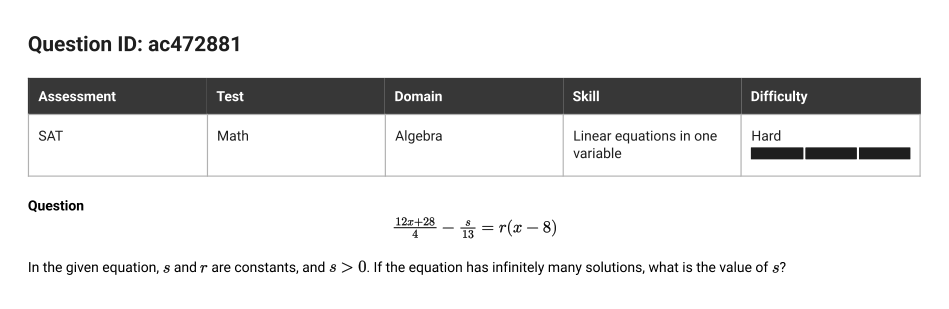
Question 1Algebra · Linear equations in one variable
ID ac472881
SAT Math question 1, ID ac472881
Select the question image to open a full-resolution view.
WHY THIS QUESTION IS IN THE GAP-COVERAGE SET
Identity + rational coefficients + parameter
The student must clear fractions and enforce two independent identity conditions: the variable coefficients and the constants must both match. This is denser than the usual one-condition infinite-solutions setup.
Official Question Bank explanation
Correct answer: 403
Official rationale for question 1
Question 2Advanced Math · Nonlinear functions
ID 512bd5b4
SAT Math question 2, ID 512bd5b4
Select the question image to open a full-resolution view.
WHY THIS QUESTION IS IN THE GAP-COVERAGE SET
Exponential form → percent change over a non-unit interval
It tests whether the student can read a percent increase from exponential structure when the input changes by a specified interval, rather than simply substitute into a familiar growth formula.
Official Question Bank explanation
Correct answer: 44
Official rationale for question 2
Question 3Problem-Solving & Data Analysis · Margin of error
ID 85939da5
SAT Math question 3, ID 85939da5
Select the question image to open a full-resolution view.
WHY THIS QUESTION IS IN THE GAP-COVERAGE SET
Margin-of-error interpretation through cautious language
The key move is interpreting what a margin of error makes plausible or doubtful. It is a wording-and-inference problem, not a calculation problem.
Official Question Bank explanation
Correct answer: Choice D
Official rationale for question 3
Question 4Geometry & Trigonometry · Right triangles
ID 2c3aefc9
SAT Math question 4, ID 2c3aefc9
Select the question image to open a full-resolution view.
WHY THIS QUESTION IS IN THE GAP-COVERAGE SET
Geometry constraint → quadratic
The Pythagorean theorem is only the first step: the side-difference condition creates a quadratic. This combines geometry and algebra rather than asking for a direct missing side.
Official Question Bank explanation
Correct answer: 38
Official rationale for question 4
Question 5Algebra · Linear equations in two variables
ID 3008cfc3
SAT Math question 5, ID 3008cfc3
Select the question image to open a full-resolution view.
WHY THIS QUESTION IS IN THE GAP-COVERAGE SET
Parametric coordinates + parametric intercept
The same parameter appears in point coordinates and in the intercept. The student has to notice that it cancels in the slope and then use the invariant slope again.
Official Question Bank explanation
Correct answer: 33
Official rationale for question 5
Question 6Advanced Math · Nonlinear functions
ID 128c75e2
SAT Math question 6, ID 128c75e2
Select the question image to open a full-resolution view.
WHY THIS QUESTION IS IN THE GAP-COVERAGE SET
Absolute value + negative parameter sign control
The difficulty is conceptual sign analysis: because the parameter is negative, evaluating an absolute value changes the apparent sign of the parameterized expression.
Official Question Bank explanation
Correct answer: 609
Official rationale for question 6
Question 7Problem-Solving & Data Analysis · Conditional probability
ID 89ff6a0a
SAT Math question 7, ID 89ff6a0a
Select the question image to open a full-resolution view.
WHY THIS QUESTION IS IN THE GAP-COVERAGE SET
Conditional probability with a complement restriction
The sample space must first be restricted to a 'not in group 2' condition. This is a strong test of denominator discipline rather than a routine probability fraction.
Official Question Bank explanation
Correct answer: .9538 / 0.9538 / 62/65
Official rationale for question 7
Question 8Geometry & Trigonometry · Circles
ID 35d37640
SAT Math question 8, ID 35d37640
Select the question image to open a full-resolution view.
WHY THIS QUESTION IS IN THE GAP-COVERAGE SET
Unit circle + coordinates + radians/coterminal angles
This combines coordinate constraints on a unit circle with positive radian measures and coterminal-angle reasoning, a noticeably different geometry/trigonometry framing.
Official Question Bank explanation
Correct answer: Choice D
Official rationale for question 8
Question 9Algebra · Linear equations in two variables
ID 9bbce683
SAT Math question 9, ID 9bbce683
Select the question image to open a full-resolution view.
WHY THIS QUESTION IS IN THE GAP-COVERAGE SET
Table → equation → translation → intercept
The question forces a four-link chain: infer the original line from a table, translate it, form the new equation, and then find an intercept.
Official Question Bank explanation
Correct answer: Choice D
Official rationale for question 9
Question 10Advanced Math · Nonlinear functions
ID d139cf4b
SAT Math question 10, ID d139cf4b
Select the question image to open a full-resolution view.
WHY THIS QUESTION IS IN THE GAP-COVERAGE SET
Function transformation/composition → extremum
The student must first build or interpret a transformed function and only then identify its maximum. The extremum is embedded inside a function-operation chain.
Official Question Bank explanation
Correct answer: Choice B
Official rationale for question 10
Question 11Problem-Solving & Data Analysis · One-variable data
ID 457d2f2c
SAT Math question 11, ID 457d2f2c
Select the question image to open a full-resolution view.
WHY THIS QUESTION IS IN THE GAP-COVERAGE SET
Data transformation invariants
Values are altered symmetrically around the median. The problem asks which statistic changes, forcing the student to reason about center versus spread rather than calculate every value.
Official Question Bank explanation
Correct answer: Choice D
Official rationale for question 11
Question 12Geometry & Trigonometry · Circles
ID c0b53183
SAT Math question 12, ID c0b53183
Select the question image to open a full-resolution view.
WHY THIS QUESTION IS IN THE GAP-COVERAGE SET
Tangents + radii + Pythagorean theorem + area
Several geometric facts must be linked: tangent-radius perpendicularity, equal tangent segments, a right triangle, and finally the area of a quadrilateral.
Official Question Bank explanation
Correct answer: 39312
Official rationale for question 12
Question 13Algebra · Linear functions
ID d4572f55
SAT Math question 13, ID d4572f55
Select the question image to open a full-resolution view.
WHY THIS QUESTION IS IN THE GAP-COVERAGE SET
Fully parametric table
A parameter is carried through every y-value. It cancels when finding slope but remains in the intercept, testing whether the student distinguishes what is invariant from what is not.
Official Question Bank explanation
Correct answer: Choice D
Official rationale for question 13
Question 14Advanced Math · Nonlinear functions
ID 1178f2df
SAT Math question 14, ID 1178f2df
Select the question image to open a full-resolution view.
WHY THIS QUESTION IS IN THE GAP-COVERAGE SET
Quadratic table symmetry → reconstruct y-intercept
The student must detect the axis of symmetry from repeated output values in a table, reconstruct enough of the quadratic, and then evaluate the y-intercept.
Official Question Bank explanation
Correct answer: -2112
Official rationale for question 14
Question 15Problem-Solving & Data Analysis · One-variable data
ID cf2be18d
SAT Math question 15, ID cf2be18d
Select the question image to open a full-resolution view.
WHY THIS QUESTION IS IN THE GAP-COVERAGE SET
Mean + median + range as simultaneous constraints
Three different summary-statistic conditions must be satisfied at once. This is a constraint-satisfaction problem rather than a single-statistic computation.
Official Question Bank explanation
Correct answer: Choice C
Official rationale for question 15
Question 16Geometry & Trigonometry · Area and volume
ID 73e1b793
SAT Math question 16, ID 73e1b793
Select the question image to open a full-resolution view.
WHY THIS QUESTION IS IN THE GAP-COVERAGE SET
Similar solids: volume scale → linear scale
The student must reverse a volume ratio into a side-length ratio using a cube-root relationship, which is less routine than direct similar-figure proportions.
Official Question Bank explanation
Correct answer: 4
Official rationale for question 16
Question 17Algebra · Systems of two linear equations
ID ff501705
SAT Math question 17, ID ff501705
Select the question image to open a full-resolution view.
WHY THIS QUESTION IS IN THE GAP-COVERAGE SET
Fractional system + no-solution parameter
The equations must first be cleared of fractions and standardized, and only then can the parallel-but-distinct condition be applied through proportional coefficients.
Official Question Bank explanation
Correct answer: 6
Official rationale for question 17
Question 18Problem-Solving & Data Analysis · Margin of error
ID 308084c5
SAT Math question 18, ID 308084c5
Select the question image to open a full-resolution view.
WHY THIS QUESTION IS IN THE GAP-COVERAGE SET
Margin of error → infer sample-size effect
Instead of interpreting an interval, this asks what causes a larger margin of error under comparable sampling conditions, testing statistical design reasoning.
Official Question Bank explanation
Correct answer: Choice D
Official rationale for question 18
Question 19Geometry & Trigonometry · Lines, angles, and triangles
ID 5b4757df
SAT Math question 19, ID 5b4757df
Select the question image to open a full-resolution view.
WHY THIS QUESTION IS IN THE GAP-COVERAGE SET
Area → missing leg → similarity → composite length
The question chains area, a parallel-line similarity relationship, a proportion, and a final segment addition. No single formula finishes it.
Official Question Bank explanation
Correct answer: 14.66 / 14.67 / 44/3
Official rationale for question 19
Question 20Algebra · Linear equations in one variable
ID 55ea0659
SAT Math question 20, ID 55ea0659
Select the question image to open a full-resolution view.
WHY THIS QUESTION IS IN THE GAP-COVERAGE SET
Discrete parameter + exactly-one solution + CANNOT
The parameter is constrained to positive integers and the answer condition is exclusionary. The student must characterize when uniqueness fails and then identify the impossible parameter.
Official Question Bank explanation
Correct answer: Choice D
Official rationale for question 20
Question 21Problem-Solving & Data Analysis · Inference from sample statistics
ID 7ce2830a
SAT Math question 21, ID 7ce2830a
Select the question image to open a full-resolution view.
WHY THIS QUESTION IS IN THE GAP-COVERAGE SET
Random sample → scope of generalization
The reasoning target is external validity: the student has to identify the largest population supported by the actual sampling frame, not simply choose the broadest population.
Official Question Bank explanation
Correct answer: Choice B
Official rationale for question 21
Question 22Geometry & Trigonometry · Lines, angles, and triangles
ID fecc446d
SAT Math question 22, ID fecc446d
Select the question image to open a full-resolution view.
WHY THIS QUESTION IS IN THE GAP-COVERAGE SET
Parallel lines + angle classes + sum + exclusion
The student must classify acute and obtuse angles created by a transversal, reason about sums of several angles, and then handle a 'could NOT' condition.
Official Question Bank explanation
Correct answer: Choice A
Official rationale for question 22
Question 23Algebra · Linear equations in one variable
ID 3f8a701b
SAT Math question 23, ID 3f8a701b
Select the question image to open a full-resolution view.
WHY THIS QUESTION IS IN THE GAP-COVERAGE SET
No-solution equation + necessary-condition statements
Rather than solving for a single constant, the problem asks which of several statements must be true for no solution. It tests logical necessity and parameter relationships.
Official Question Bank explanation
Correct answer: Choice D
Official rationale for question 23
Question 24Geometry & Trigonometry · Circles
ID 44d67c6c
SAT Math question 24, ID 44d67c6c
Select the question image to open a full-resolution view.
WHY THIS QUESTION IS IN THE GAP-COVERAGE SET
Complete square → scaled circle → point substitution
The student must identify a circle's center and radius from a nonstandard equation, enlarge the circle, and then use a point on the new circle to recover a parameter.
Official Question Bank explanation
Correct answer: -2
Official rationale for question 24
Question 25Algebra · Systems of two linear equations
ID 9b7a1b67
SAT Math question 25, ID 9b7a1b67
Select the question image to open a full-resolution view.
WHY THIS QUESTION IS IN THE GAP-COVERAGE SET
Graph + no-solution system + excluded parameter
This combines visual graph reading, parallel-line logic, and a 'NOT possible' parameter condition. It is a different reasoning path from solving an algebraic system directly.
Official Question Bank explanation
Correct answer: Choice A
Official rationale for question 25Official rationale for question 25
Question 26Advanced Math · Nonlinear equations in one variable
ID 9a1f1941
SAT Math question 26, ID 9a1f1941
Select the question image to open a full-resolution view.
WHY THIS QUESTION IS IN THE GAP-COVERAGE SET
Absolute value equals a negative number → zero solutions by definition
This is a pure definition-and-domain trap. The student must recognize immediately that an absolute-value expression is nonnegative, so it cannot equal a negative number. The reasoning is structural rather than computational.
Official Question Bank explanation
Correct answer: Choice A
Official rationale for question 26
Question 27Advanced Math · Nonlinear functions
ID 18e35375
SAT Math question 27, ID 18e35375
Select the question image to open a full-resolution view.
WHY THIS QUESTION IS IN THE GAP-COVERAGE SET
Factored quadratic → find minimum using midpoint of roots
The quadratic is presented in a form that exposes its zeros rather than its vertex. The useful move is to recover the vertex x-coordinate as the midpoint of the two roots, so students practice moving between quadratic representations.
Official Question Bank explanation
Correct answer: Choice D
Official rationale for question 27
Question 28Advanced Math · Nonlinear functions
ID 6d9e01a2
SAT Math question 28, ID 6d9e01a2
Select the question image to open a full-resolution view.
WHY THIS QUESTION IS IN THE GAP-COVERAGE SET
Standard-form quadratic → complete the square / vertex formula for x of minimum
This complements the factored-form item: here the minimum x-coordinate is not visible. Students must transform standard form or use the vertex relationship, reinforcing representation choice rather than rote substitution.
Official Question Bank explanation
Correct answer: 25/4 / 6.25
Official rationale for question 28
Question 29Advanced Math · Nonlinear functions
ID a7711fe8
SAT Math question 29, ID a7711fe8
Select the question image to open a full-resolution view.
WHY THIS QUESTION IS IN THE GAP-COVERAGE SET
Direct reading of minimum value from vertex form
This is the third representation in the mini-ladder. The challenge is distinguishing the x-coordinate of the vertex from the minimum function value and reading the correct quantity directly from vertex form.
Official Question Bank explanation
Correct answer: Choice A
Official rationale for question 29
Question 30Algebra · Systems of two linear equations
ID 59813abf
SAT Math question 30, ID 59813abf
Select the question image to open a full-resolution view.
WHY THIS QUESTION IS IN THE GAP-COVERAGE SET
Given one equation with positive parameter → choose second equation that produces no solution
The student must use proportional x- and y-coefficients together with a nonproportional constant to create parallel distinct lines. The positive-parameter condition matters when checking the constant ratio.
Official Question Bank explanation
Correct answer: Choice D
Official rationale for question 30
0 of 30 answered